
How can public purchasing create better opportunities for social enterprises while delivering measurable benefits for communities? This question is at the centre of the Deal4Good training curriculum for Social Procurement Experts.
Socially Responsible Public Procurement uses public purchasing to generate positive social and ethical outcomes. The European Commission promotes the wider use of socially responsible criteria in public procurement across the European Union. Deal4Good contributes to this objective by strengthening the knowledge and practical skills of professionals who support social enterprises in accessing public procurement opportunities.
A practical curriculum for Social Procurement Experts
The Deal4Good curriculum consists of eight complementary modules:
- Introduction to Social Public Procurement and the Social Economy
- Legislation and Regulations
- Analysis of Social Enterprises’ Needs
- Bid Preparation and Presentation
- Contract Management and Social Impact Monitoring
- Partnerships between Social Enterprises and Contracting Authorities
- Social Impact Assessment
- Advocacy and Policy Influence
The curriculum combines essential knowledge with practical tools, examples and activities. It supports learners throughout the procurement process; from understanding the policy and legal context to preparing bids, managing contracts, measuring social impact and building effective partnerships.
The training is designed for a broad range of users, including social-enterprise and NGO staff, VET trainers and providers, SMEs, students and graduates, business-support organisations, public authorities and contracting authorities.
After completing the training and demonstrating the expected learning outcomes, successful participants received certificates and Digital Competence Badges describing the knowledge, skills and competences acquired.
The curriculum tested in eight countries
Between June and September 2026, the Deal4Good partnership piloted the curriculum in Germany, Romania, Bulgaria, Spain, Italy, Malta, Cyprus and Greece.
The transnational pilot made it possible to test the same training pathway in different national contexts and with participants who had varying levels of experience in social economy and public procurement.
Pilot training in figures
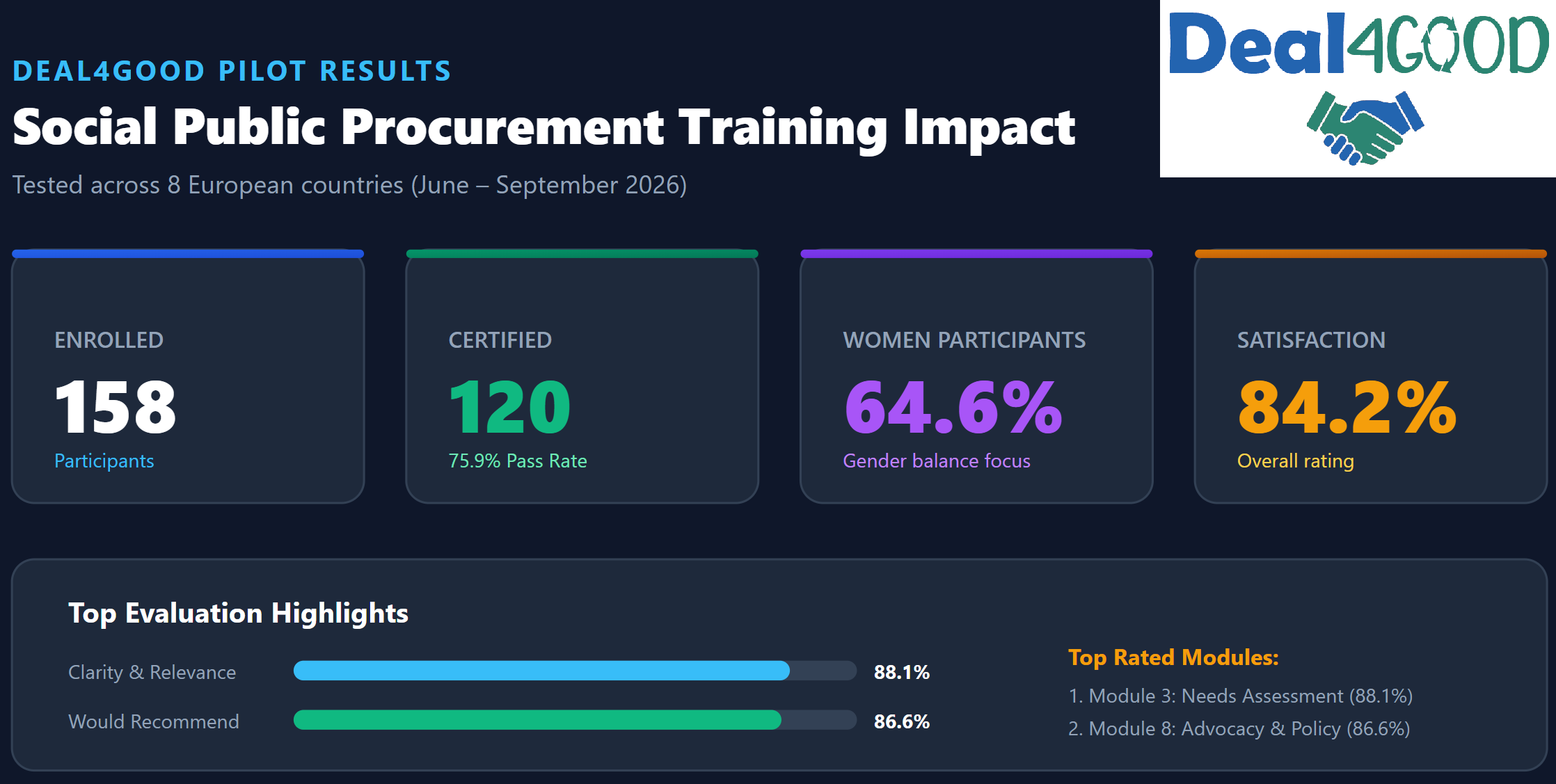
- 8 European countries involved
- 158 participants enrolled
- 120 participants successfully certified
- 75.9% overall certification rate
- 64.6% of enrolled participants were women
- 84.24% overall participant satisfaction
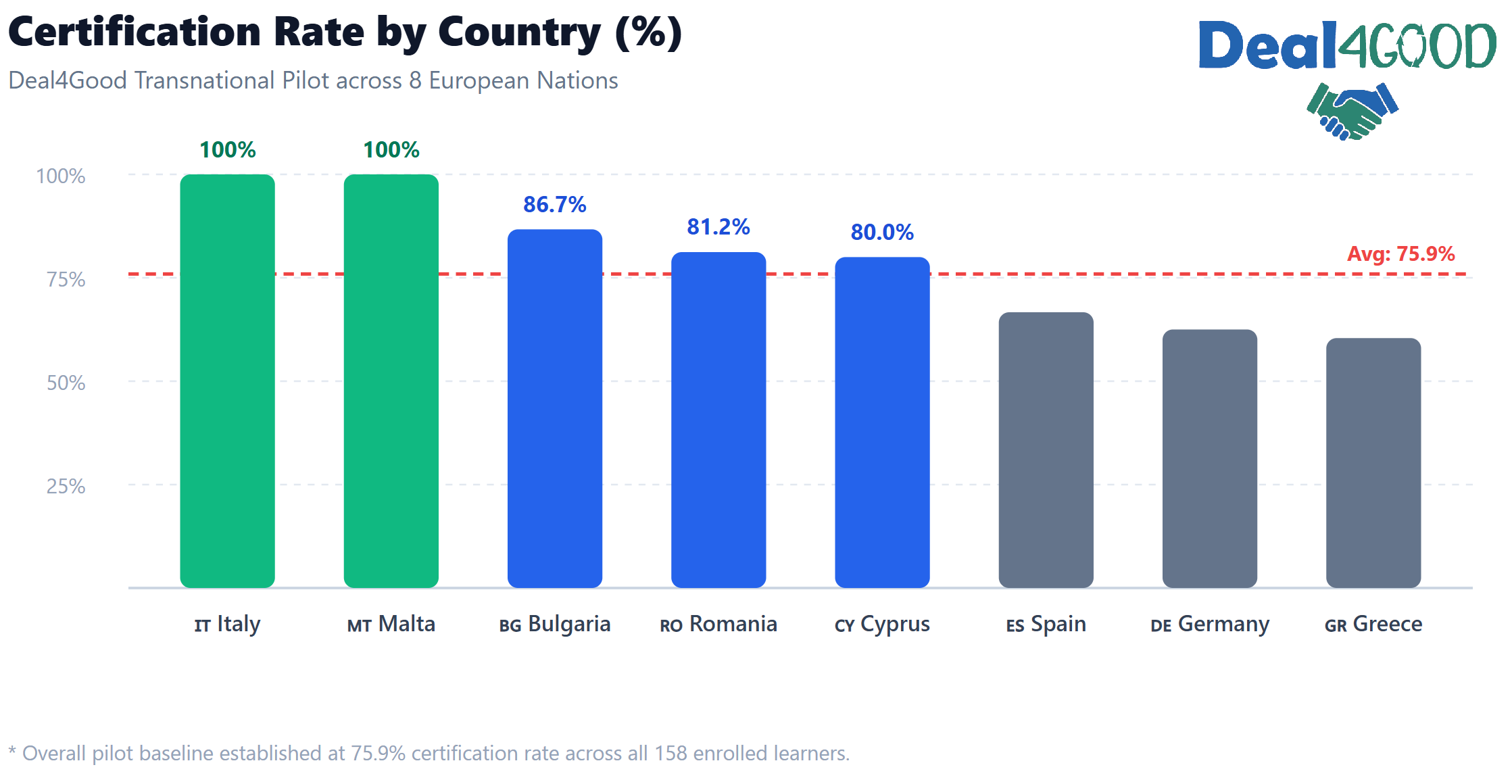
Italy and Malta achieved certification rates of 100%, followed by Bulgaria with 86.7%, Romania with 81.2% and Cyprus with 80%. The pilot therefore demonstrated both strong demand for the training and a substantial level of completion across the partnership.
Strong participant satisfaction
The evaluation findings provide clear validation of the curriculum. Participants assessed the training positively in relation to its objectives, relevance, structure, content, learning materials and balance between theory and practice.
Among the all respondents:
- 88.1% gave the highest rating for the clear explanation of the training objectives;
- 88.1% gave the highest rating for the relevance of the content to their work or professional interests;
- 85.1% gave the highest rating for the clarity of the topics;
- 83.6% gave the highest rating for the usefulness and practicality of the materials;
- 86.6% gave the highest rating when asked whether they would recommend the training.
What participants valued most
All eight modules received strong evaluation results. Module 3, focusing on the analysis of social enterprises’ needs, received the highest proportion of top ratings at 88.1%. Module 8 on advocacy and policy influence followed closely, with 86.6% awarding the highest rating.
Open feedback also highlighted the practical value of:
- bid preparation and presentation;
- social impact assessment;
- partnerships between social enterprises and contracting authorities;
- contract and social impact monitoring;
- understanding the foundations of social procurement and the social economy.
Participants reported improved knowledge of SPP concepts and legislation, greater confidence in preparing bids, and a better understanding of contract management, impact measurement, partnership building and advocacy.
Many participants intend to apply their learning in their professional activities, improve proposals and tender submissions, integrate social criteria into organisational practices, share the knowledge with colleagues and explore new project, career and procurement opportunities.
Learning from the pilot
The pilot confirmed the relevance and overall structure of the curriculum while also identifying opportunities for improvement.
Participants requested more real-life examples, simulations, videos, interactive exercises and practical resources. Their suggestions included bid-preparation templates, checklists, impact-measurement frameworks, partnership agreement models, examples of real tenders and concise summaries of the main learning points.
The most frequently requested areas for additional support were:
- bid preparation – 26.9%;
- social-enterprise needs assessment – 23.9%;
- social impact measurement – 23.9%;
- legal frameworks, contract management, advocacy and partnership building – 19.4% each.
These findings will guide the next stage of curriculum fine-tuning. The partnership will retain the complete eight-module structure while making selected content shorter, clearer, more visual and even more practice-oriented.
Moving towards the final curriculum
The pilot results show that the Deal4Good curriculum responds to a real capacity-building need. It provides social-economy actors and the professionals supporting them with the knowledge and tools required to engage more effectively in Social Public Procurement.
With 158 learners involved, 120 participants certified and an overall satisfaction score of 84.24%, the pilot represents an important milestone for the project.
The feedback collected across the eight partner countries will now support the delivery of an accessible, practical and learner-centred final curriculum; helping turn social procurement principles into concrete opportunities and measurable social impact.